Get In-Depth Data to Fuel Your Strategy
The Connected Fitness category, ranging from performance wearables to smart cycling platforms, has quietly become one of the most dynamic corners of the sports sponsorship world. SponsorUnited is currently tracking 53 active brands and over 1,000 deals across the 2025-26 season — a category that punches well above its weight and is only getting more competitive. These brands are showing up across pro sports, endurance events, influencer channels, and global football in ways that would have seemed unlikely just a few years ago.
The wellness economy has reached $6.3 trillion globally, and in the U.S. alone, 40% of adults use health apps and 35% use wearables — with 61% wearing devices daily. More than 80% are willing to share their health data with their doctors. That kind of consumer engagement is exactly what makes Connected Fitness brands such attractive sponsorship partners — and why properties across sports, entertainment, and media are increasingly rolling out the red carpet for them.
The Category at a Glance
A few numbers from the SponsorUnited platform that frame the opportunity:
- 53 active brands are buying sponsorships or media in this category
- 5.6 sponsorship deals per brand on average — and 15.9 total deals per brand when media is included
- 28% of brands have 5+ active sponsorship deals, signaling a category with real depth, not just a handful of headline buyers
- 93% property availability — only a fraction of opportunities have been sold, meaning rights holders still have significant inventory open to Connected Fitness brands
- 54% of deals include an Instagram post, the single most-used asset type in the category
5 Noteworthy Activations
The biggest deals in this space tell the story of a category growing up fast. Here are five deals breaking new ground.
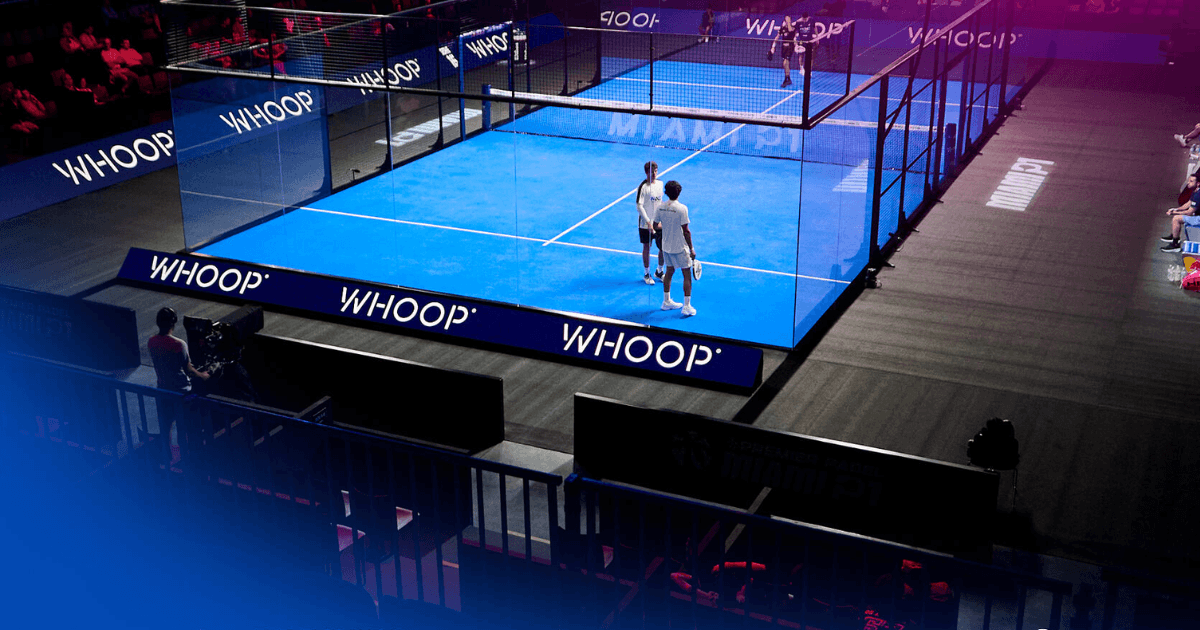
WHOOP has been on an absolute tear. The brand raised $575M in a Series G at a $10.1B valuation and has been deploying that capital into high-profile sports partnerships — Paris Saint-Germain, the Ryder Cup, the UCI Mountain Bike World Series (as title sponsor), Premier Padel (a three-year global deal), and the British & Irish Lions Tour to Australia. Lewis Hamilton is wearing a WHOOP band this F1 season.
Oura Ring has been equally aggressive, having raised over $900M to date. The brand is now the Official Wearable of Team USA and the LA28 Olympic and Paralympic Games, holds a landmark five-year deal with the USTA/US Open (every main-draw competitor receives an Oura Ring), and was named the Official Wearable of U.S. Soccer in April 2026. The PTPA (Professional Tennis Players Association) also provides Oura Ring 4 access to its members.
Peloton has pivoted hard toward platform partnerships. The brand is now the Official Fitness Partner of the Formula 1 Heineken Las Vegas Grand Prix, has expanded its gym partnerships (LA Fitness, YMCA), and launched a new AI and computer vision system to guide users across all equipment. Its TikTok #TikTokFitness Peloton Hub partnership is another example of the brand leaning into digital-first activations.
Catapult Sports continues to be the quiet giant — partnered with all 32 NFL teams, the NBA, all 12 Super League rugby clubs, and recently renewed with the Ligue National Rugby (Top 14 and Pro D2) while signing a new multi-year deal with the Rugby Football Union, Premiership Rugby, and Premiership Women's Rugby. With 5,000+ teams across 28 global locations, Catapult's “deals” are really enterprise technology contracts — which explains the volume-to-spend gap.
Strava has built a unique B2B sponsorship model around its platform — Sponsored Challenges, branded Clubs, and Segments that let brands incentivize activity directly within the app. With 93 deals in 2025-26 (up from 40 in 2023-24), it's the category's most improved brand by growth rate.
Where the Deals Are Going
Lifestyle influencers are the single biggest destination for Connected Fitness deals, accounting for nearly a third of all activity. Fitness wearables and apps live and die by authentic, community-driven endorsement, so this makes intuitive sense. Global Football is the second-largest category, driven heavily by Catapult Sports' performance technology deals with clubs across Europe and beyond. Endurance & Action Sports — marathons, triathlons, cycling — round out the top three, which is the natural home turf for Wahoo Fitness, Zwift, Strava, and Garmin.
At the property level, the top destinations in the current season include CES (with 13 Connected Fitness brands present), cycling teams Alpecin Premier Tech and Lidl-Trek, streaming platforms Hulu and Netflix, the Tour de France, the New York City Marathon, and several Ligue 1 clubs. The streaming platform presence is a newer signal worth watching — it suggests these brands are starting to buy media inventory alongside traditional sponsorships.
The Whitespace: Major U.S. Pro Sports
Here's the opportunity hiding in plain sight. Across the five major U.S. pro leagues — NBA, NHL, MLS, NFL, and MLB — Connected Fitness brands have spent just $2.17M in total. Most of that activity is concentrated on athletes, not teams or leagues themselves.
That's a striking gap given how aggressively this category is showing up everywhere else. Connected Fitness brands have title sponsorships in cycling, official partner status with national federations, and presence at every major endurance event — but the team-level inventory across the NBA, NHL, MLS, NFL, and MLB is still largely untouched. For a brand looking to plant a flag in U.S. sports, this is open territory: official team partnerships, in-venue activation, performance technology integrations, and league-level Official Wearable / Official Recovery / Official Training Partner designations are all on the table.
The athlete endorsement playbook is well-trodden. The team and league playbook is wide open.
The Digital Shift Is Real — and Accelerating
Digital deals now make up 63% of all Connected Fitness activity, the highest share across the three seasons SponsorUnited tracks. That's up from 53% in 2023-24, a meaningful shift. TV deals have declined from 9.2% to 6.8% over the same period. Radio has nearly disappeared (from 2.8% to 0.6%).
The message is clear: Connected Fitness brands are following their audiences online, investing in influencer content, social media, and streaming over traditional broadcast. The most-bought assets in the category — Instagram Video Post, Instagram Image Post, TikTok Sponsored Post — reflect a playbook built around creators and short-form content. Endorsement Rights (13%) and Performance Equipment Provided are also high on the list, signaling that authenticity and product-in-use storytelling remain the category's center of gravity.
What's Driving the Trend
Five macro forces are converging to make Connected Fitness one of the most interesting sponsorship categories to watch:
- Wearables are going mainstream. The shift from niche fitness gadget to everyday health tool is accelerating. Oura and WHOOP are now in the same conversation Fitbit occupied a decade ago — but with far more sophisticated data and far more ambitious partnership strategies.
- Sports are becoming a proving ground for health tech. Official wearable partnerships with leagues and federations (Team USA, U.S. Soccer, USTA) serve a dual purpose: they validate the technology and generate massive consumer awareness. Expect more of these “official wearable” deals as the category matures.
- The digital-first playbook is winning. With 63% of deals now in the digital category, Connected Fitness brands have clearly figured out where their audiences live. Influencer partnerships — especially in health, fitness, and lifestyle — are the primary activation vehicle.
- Enterprise tech is blurring the lines. Brands like Catapult, Hudl, and Sony are operating at the intersection of sports science and sponsorship, embedding their technology into how leagues and teams actually function. These aren't traditional sponsorships — they're infrastructure deals.
- Endurance sports remain the heartland. Marathons, triathlons, cycling tours, and road races are where Connected Fitness brands have the most natural fit — and the most engaged audiences. The Tour de France, NYC Marathon, and UCI Mountain Bike World Series are all prime real estate for this category.
The Takeaway
Connected Fitness is no longer a niche. It's a category with a consistent growth story, a clear playbook, and a roster of brands willing to spend at the highest levels of sport. For rights holders, the implications are significant: with 93% of property inventory still open to this category and an average of 5.6 sponsorship deals per brand, the runway for new partnerships is wide. And for the major U.S. leagues specifically, the $2.17M spent at the team level represents a near-empty field — one that the next wave of Connected Fitness category leaders will almost certainly look to fill.
.png)
.png)
%20(2).png)
.png)
.png)
.png)
.png)
.png)
.png)
%20(1).png)
.png)
.png)
.png)
.png)
.png)

.png)
.png)
%20(1).png)

.png)
.png)
.png)
.png)
.png)
.png)
.png)
.png)
.png)
.png)





.png)


















.jpg)


.png)