Get In-Depth Data to Fuel Your Strategy
Trend #5: Women’s Sports Sponsorship Enters Its Enterprise Era
This new series examines trends we are seeing across sports sponsorships with supporting data insights from our industry-leading platform.
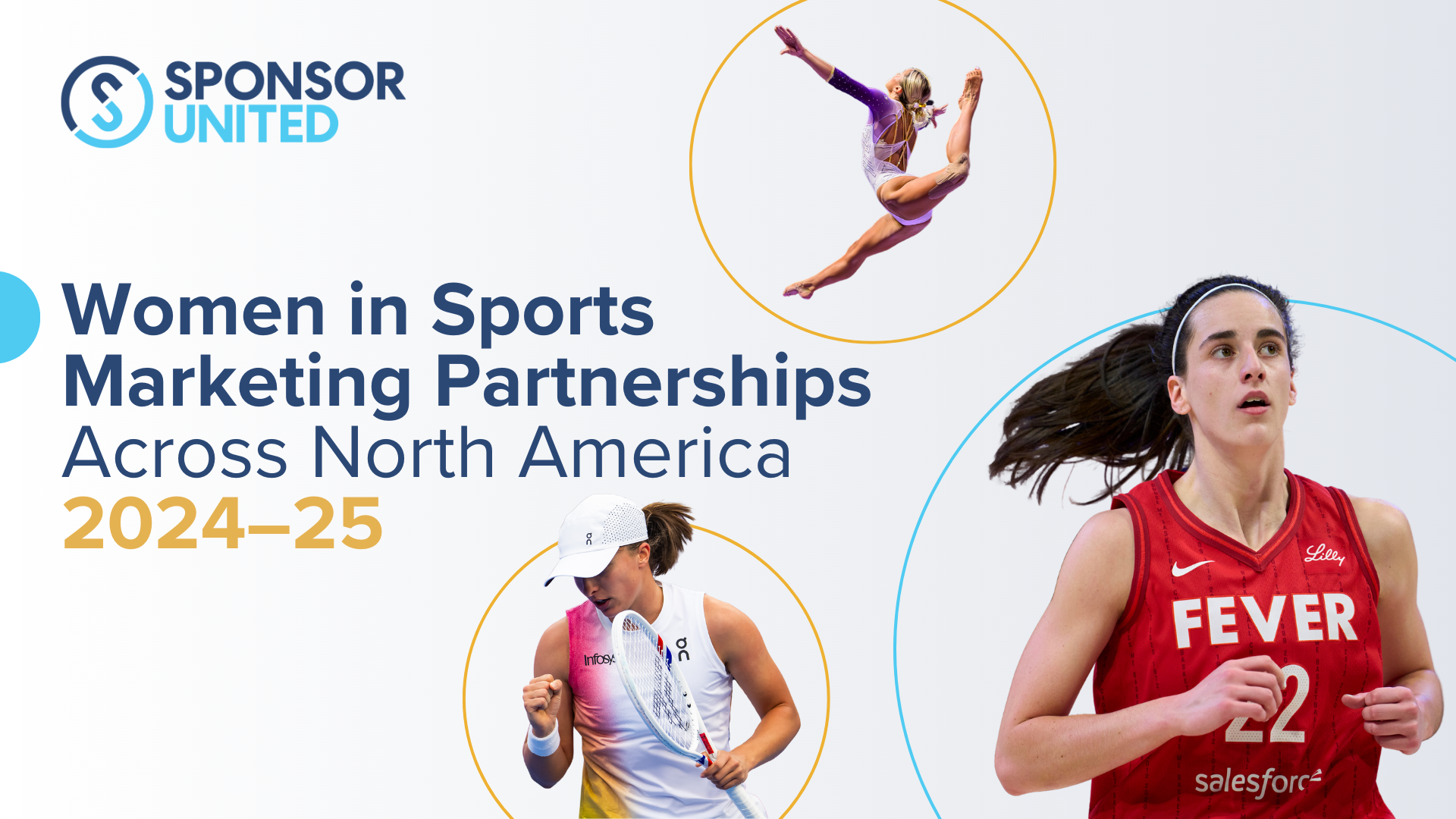
Players like Caitlin Clark stretching the limits of shooting range, A'ja Wilson leading a championship powerhouse, and Sophia Smith turning a burst of space into a goal are driving one of the most dynamic periods in the history of women’s sports. Arenas are louder, highlights travel instantly across social media, and a new generation of fans is showing up wearing the jerseys of players they grew up watching.
But the shift underway in women’s sports extends well beyond the court and the pitch.
Behind the rising attendance, expanding media coverage, and growing cultural momentum, the economics of these leagues are evolving as well. Sponsorship investment across the WNBA and NWSL is accelerating — and the way that capital is entering the market suggests something deeper than a temporary surge in attention.
Over the past several years, the growth of women’s sports has been measured through rising attendance, new media deals, and increasing cultural visibility. What has received less attention is how sponsorship capital is behaving beneath those surface indicators.
Across the WNBA and NWSL, the data increasingly suggests a shift from experimental brand spend to scaled, enterprise-level investment. The leagues are not simply growing — they are beginning to exhibit the structural characteristics of mature sponsorship markets.
Growth alone, however, does not define market maturity. The composition of that growth does. Let’s look at the WNBA and NWSL in particular.
The WNBA: Upmarket Expansion and Capital Concentration
The WNBA’s sponsorship market expanded 45% year-over-year, growing from $72.3 million in 2024 to $105 million in 2025. Deal volume increased 20%, brand participation rose 16%, and average deal size climbed 21%.
That combination — rising participation alongside larger commitments — signals more than simple market growth. It suggests that brands already participating in the league are increasing conviction rather than merely testing the category.
Several enterprise sectors drove the increase in average deal spend, including Consumer Products (+242%), Consumer Services (+174%), Healthcare (+112%), and Financial (+27%).
The presence of Healthcare and Financial among the fastest-growing categories is particularly instructive. These sectors typically prioritize measurable reach, stable platforms, and long-term brand alignment. Their expansion within the WNBA often signals growing institutional confidence in the league’s audience and commercial trajectory.
Taken together, the league’s sponsorship profile is beginning to resemble that of an established major-league property. Larger commitments, increasing category concentration, and premium asset agreements suggest pricing power is beginning to consolidate within the WNBA sponsorship ecosystem.
The NWSL: Broadening Participation and Market Penetration
The NWSL is exhibiting a different — but equally important — investment pattern.
Total sponsorship investment increased 21% year-over-year, rising from $75 million to $90.5 million. Deal volume expanded 59%, and brand participation grew 28%. At the same time, average deal size declined 24%.
Viewed in isolation, a decline in average commitment might raise concerns. In context, it more closely reflects a market penetration phase.
A wave of new entrants — particularly across Technology, Apparel & Accessories, and Construction & Industrial categories — drove a surge in deal activity at lower initial spend thresholds. Technology alone added 38 net new deals year-over-year, highlighting how quickly brands are moving to establish a presence within the league.
This pattern suggests the NWSL is rapidly widening its sponsorship base, bringing new brands into the ecosystem through entry-level commitments. Historically, this phase often precedes consolidation, as high-performing categories deepen investment and pricing begins to stabilize.
Taken together, the WNBA and NWSL illustrate two complementary phases of commercial development: one consolidating upward, the other broadening outward.
Category Signals: Volume Versus Capital
Category behavior across both leagues provides additional insight into how the market is evolving.
By net new deal volume, the categories driving expansion were Technology (+38), Beverage – Non-Alcoholic (+32), Consumer Products (+27), and Auto (+26). These gains reflect experimentation and increasing participation as brands establish an initial presence within women’s sports.
By total sponsorship dollar growth, however, a different group leads: Financial (+~$9 million), Consumer Products (+~$5.5 million), Healthcare (+~$5.5 million), and Transportation (+~$4.4 million).
The distinction between volume growth and capital concentration is meaningful. Technology is expanding participation across the sponsorship landscape, while Financial and Healthcare are scaling investment.
As noted with the WNBA, when financial institutions increase investment within a sports property, it often signals confidence in audience quality, measurement stability, and long-term media trajectory. Meanwhile, Consumer Products’ presence on both lists — driven in part by growth in Cosmetics and Skin Care — suggests certain subcategories are shifting from opportunistic brand visibility to more strategic portfolio allocation.
Sephora’s naming rights agreement with the Golden State Valkyries illustrates this evolution: brands are moving beyond basic presence toward premium, high-visibility assets.
Taken together, these dynamics are consistent with markets transitioning beyond early acceleration toward structural normalization.
Alcohol: Redistribution Rather Than Withdrawal
Beverage Alcohol led all categories in deal volume in 2025, but total sponsorship spending declined year-over-year. Five large brands reduced investment, accounting for roughly $2.5 million in pullback.
That decline, however, was partially offset by a broader wave of smaller commitments from mid-tier and emerging brands entering the category. The result appears to be redistribution rather than retreat.
As sponsorship ecosystems mature, anchor brands often recalibrate their exposure while smaller competitors move in to establish share. Competitive density increases even as average commitments fluctuate. In this context, the alcohol category’s shifting investment pattern is less a signal of weakening demand and more an indication of a market becoming more competitive and diversified.
Asset Strategy Is Evolving Alongside Capital
The growth in sponsorship investment has also coincided with changes in how deals are structured.
Across both leagues, partnerships are becoming increasingly activation-led, with brands placing greater emphasis on in-venue digital inventory, integrated fan experiences, and multi-platform visibility — trends that mirror rising attendance and expanding media reach.
Major asset agreements from companies such as Sephora, Kaiser Permanente, Cash App, Ring, and Mars reflect this shift toward more integrated, high-visibility partnerships.
As sponsorship markets mature, brand strategy typically evolves from simple logo presence to deeper ecosystem integration — where partnerships span digital, in-venue, broadcast, and community touchpoints.
The current data suggests women’s sports are entering that stage.
Implications for Brand Leaders
Women’s sports sponsorship is no longer defined solely by growth. Increasingly, it is shaped by capital concentration, category stratification, and evolving asset strategies.
For brand marketers, this creates a more complex competitive landscape. Pricing dynamics are beginning to shift in select properties. Category density is rising in high-growth sectors. And the early-entry advantage that once characterized women’s sports sponsorship is narrowing in leagues experiencing rapid upmarket movement.
Participation alone is no longer a differentiator. Strategic positioning within the sponsorship ecosystem — by category, asset class, and competitive set — is becoming more consequential.
In March, SponsorUnited will release a comprehensive Women’s Sports Sponsorship Intelligence Report examining category behavior, asset mix evolution, and cross-property patterns across additional professional women’s leagues. As investment accelerates, disciplined benchmarking and competitive visibility will become increasingly central to sponsorship strategy.
Women’s sports are not simply expanding. They are entering a phase where structure, scale, and strategy matter more than ever.
.png)

%20(1).png)
.png)
.png)
%20(1).png)
.png)
.png)
.jpg)
.jpg)
.jpg)


.png)












.jpeg)

.png)





.png)

.png)


_page-0001.jpg)