Get In-Depth Data to Fuel Your Strategy
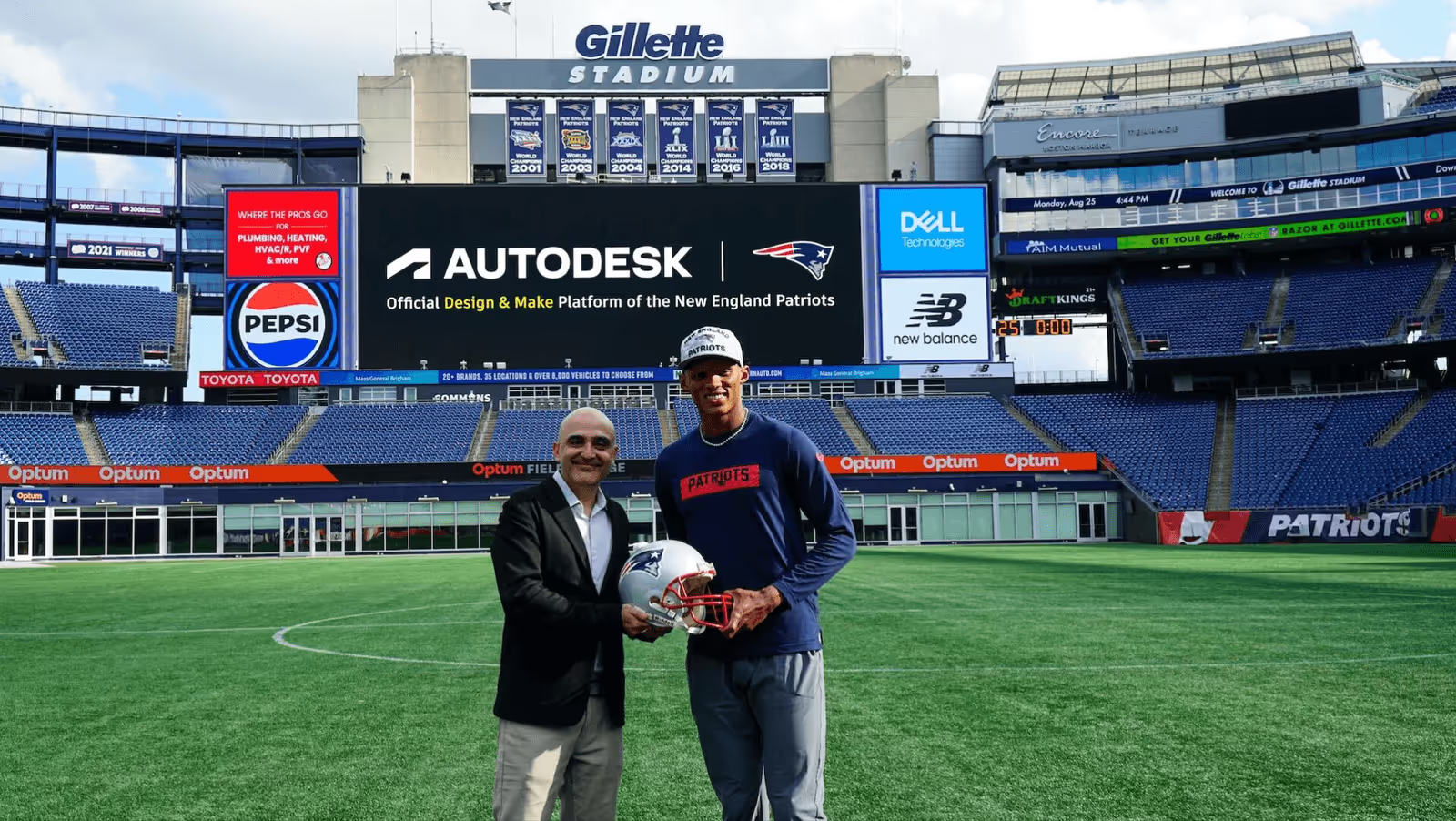
This September, software giant Autodesk partnered with the New England Patriots, marking a new chapter in sports partnerships—one rooted not just in brand storytelling, but in the future of how stadiums and major sports facilities are designed, built, and operated. The Patriots and the Kraft Group became the first NFL franchise to adopt Autodesk as their official design and make platform, integrating the company's technology directly into multi-year capital projects across their footprint.
Autodesk's software products and services power the full lifecycle of how the world is built, spanning design, simulation, construction, and operations for everything from skyscrapers and stadiums to roads, vehicles, and more. As Sidharth Haksar, Vice President and Head of Construction Strategy and Partnerships at Autodesk, puts it: “We are the only true design-and-make platform. Anything and everything that touches the physical or digital world can be designed and then executed using our tools.” In architecture, engineering, and construction (AEC), Autodesk's largest vertical, the company's solutions enable owners, architects, engineers, and contractors to operate in one integrated environment.
That level of operational alignment—touching planning, execution, and long-term performance—quickly became the foundation for a new kind of sports partnership model that is being led by Athlete-Driven Worldwide. And momentum is accelerating. Working in partnership with Athlete-Driven, Autodesk is expanding upon this strategy, recently announcing a major partnership with the Cleveland Browns, one of the NFL's oldest franchises, who will soon be breaking ground on a $2.4 billion state-of-the-art new stadium, the new Huntington Bank Field. The team will leverage Autodesk to design, construct, and operate their next-generation facility, including the creation of a full digital twin.
SponsorUnited played a role in validating this emerging approach. “Some of the year-end SponsorUnited reports on the growth in construction caught my interest,” explains CEO & Head of Partnerships Chris Lobono of Athlete-Driven Worldwide, who is advising Autodesk throughout this work. “It was one of the fastest-growing categories, and I told my team: This is a growing market of opportunity. Teams are always building, always upgrading, always improving. It's an area where our clients and our team partners can tell an authentic business story.”
Autodesk, with guidance from Athlete-Driven, has developed a new partnership structure—one where the company becomes a long-term, operationally embedded partner to NFL franchises. We chatted with Haksar to explore the impact of this new approach, the innovation behind the model, and what it means for the future of sports infrastructure.
Q: How did Autodesk's first NFL deal with the New England Patriots come together?
S.H.: It began through our Make It Real initiative, which introduces students to Autodesk tools and encourages careers in the building trades. We were already working with athlete ambassadors, including Joshua Dobbs. When Dobbs moved to New England, Athlete-Driven approached us about partnering with the Patriots.
Because Boston is ground zero for our AEC business—and because the Kraft Group is constantly building and innovating—it was a perfect fit. The Patriots could serve as a showcase for how Autodesk brings general contractors, specialty contractors, and engineering firms together on a single platform. It was immediately clear that, strategically, it made sense.
Q: Have any projects already leveraged Autodesk's platform?
S.H.: Yes. The Patriots' new practice facility, opening in spring, was designed using Autodesk tools. We're also excited about the New England Revolution's stadium project, which will run end-to-end on our platform once it advances from planning to construction.
Q: Why push into the NFL as a new category?
S.H.: Construction is still one of the least digitized industries. Projects run late and over budget partly because owners lack full visibility into workflows and are reliant on disconnected technologies. We believe owners need to become the “digital drivers” of their projects.
NFL teams are ideal partners because they're constantly building—stadiums, practice facilities, fan amenities—and they're deeply invested in long-term operational performance. Stadiums also offer universal storytelling power. When people walk into a venue, they intuitively understand the complexity behind what they're experiencing.
Q: What kinds of brand assets did Autodesk pursue with the Patriots?
S.H.: A mix of TV-visible LED signage, radio integrations, and team-owned media. The end-zone LED has been particularly impactful because people instantly connect the Autodesk brand with the Patriots.
We're also investing in editorial storytelling—content like “Building the Next Legacy”—that highlights how facilities are designed, constructed, and improved using our platform.
Q: You recently added a new NFL team partnership?
S.H.: This week we announced our new partnership with the Cleveland Browns. Their $2.4-billion new stadium has already broken ground. Autodesk is the official design and make platform, supporting ongoing updates to the current stadium as well.
The team will receive a full digital twin when the stadium is delivered—something that radically changes how owners manage operations, maintenance, and sustainability.
Q: Will fans see Autodesk's presence immediately?
S.H.: Yes. LED integrations, digital assets, team content—similar to what we've done with New England. We now have a playbook that pairs real construction outcomes with meaningful brand visibility.
Q: These are multi-year builds. How long are the deals structured for?
S.H.: These are multi-year deals by nature, which align with most construction windows. But in reality, these are long-term relationships. Stadiums evolve constantly—new hospitality spaces, new technical requirements, new sustainability goals—so our aim is to support teams throughout their modernization journey.
Q: How does Autodesk define success in these partnerships?
S.H.: Autodesk measures success in these NFL stadium partnerships in three ways, each grounded in the generational loyalty that defines football communities.
First is brand awareness: architects, engineers, contractors, and subcontractors aren't just industry pros who watch games—they're part of a generation of fans, loyal and passionate, so seeing Autodesk helping build their home stadium feels personal and instantly meaningful.
Second is the owner mandate that puts "Autodesk Construction Cloud" at the center of the work, cutting through resistance to change and letting teams experience the value directly on projects that matter to them.
Third is storytelling: We're capturing and sharing the renovation and development of these venues in real time as a community narrative. Because in every NFL city across America, these project teams are ultimately building for their own—showing up to work each day as passionate fans helping shape the future of their team's home. That authenticity is the point, and it's what turns partnership visibility into real, lasting Autodesk brand loyalty for our end users of "Autodesk Construction Cloud."
Q: How does sustainability factor into the Design & Make platform?
S.H.: It's central. Construction waste makes up about 40% of landfill volume globally. Digitization reduces errors, overordering, and rework. Our tools can even calculate embodied carbon in materials so teams can make informed decisions.
With digital twins, teams can monitor energy use, occupancy patterns, and operational performance in real time. We're one of the most sustainability-focused companies not only in the technology sector but globally with our recent recognition on the Forbes' 2025 Net Zero Leaders List—and these projects let us apply that company-wide commitment to a net-zero future meaningfully.



.png)
.png)